Across China and beyond, emerging technologies—from AI and digital twins to 3D scanning and immersive media—are reshaping how cultural heritage is documented, conserved, interpreted, and transmitted.
Digital Documentation and Preventive Conservation
[Photo via Xinhua News Agency]
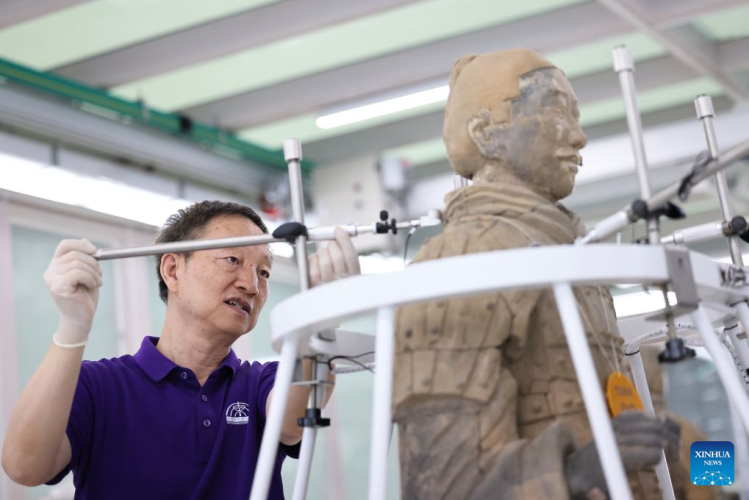
At the Emperor Qinshihuang's Mausoleum Site Museum in Xi'an, Shaanxi Province, a newly launched on-site conservation lab in Pit No. 1 allows visitors to witness the meticulous restoration of over 2,000-year-old terracotta warriors. The lab, which officially opened in 2024 to mark the 50th anniversary of the warriors' discovery, forms—together with a professional excavation and preservation facility completed in Pit No. 2—a full-cycle conservation system covering excavation, transportation, restoration, and storage. Buried underground for millennia, the warriors suffered severe damage from fires, soil collapses, and underground water fluctuations, with most original colors fading over time. Newly unearthed painted relics are now directly transferred to the on-site lab, where stable humidity control, ultrasonic inspection, 3D scanning, professional cleaning, and reinforcement treatment are deployed to preserve the warriors' ancient original hues. This approach exemplifies the shift from passive rescue to active prevention that digital technologies are enabling across the heritage sector.
[Photo via People's Daily Online]
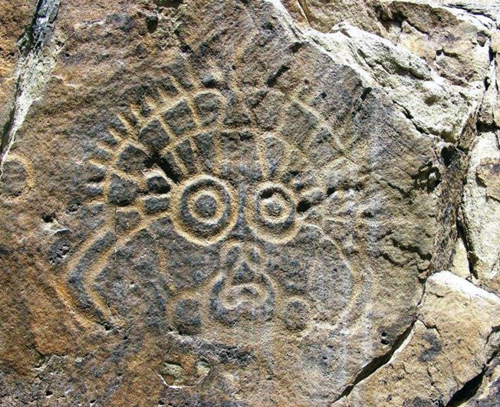
In the Helan Mountains of Ningxia Hui Autonomous Region, a new round of comprehensive surveys launched in 2020 has discovered more than 500 previously unrecorded cliff paintings. Unlike earlier surveys that relied primarily on manual field work, this round combines traditional field surveys with specialized modern technological methods. 3D laser scanners record carving marks on cliffs with greater clarity; drones are deployed over valleys to collect data from multiple angles; and a new positioning system keeps location errors within two to three meters, allowing professionals to navigate directly to target sites and greatly reducing field survey workloads. The Helan Mountains are home to more than 20,000 cliff paintings created between approximately 10,000 and 3,000 years ago, depicting over 100 types of natural imagery—human faces, animals, plants, handprints, symbols—as well as scenes of herding, hunting, sacrificial rituals, and warfare. Among the newly discovered paintings is a rare depiction of a carriage drawn by four horses, the first of its kind found in the Helan Mountains and a rarity nationwide, filling a gap in the local rock art collection. Modern technologies are also helping to sustain preservation of these treasures, which have been exposed to the elements for tens of thousands of years.
AI for Restoration, Reconstruction, and Research
AI is transforming not only preservation but also restoration and scholarly research. In Jingdezhen, Jiangxi Province—where "Jingdezhen Handicraft Porcelain Industry Heritage" was inscribed on the UNESCO World Heritage List at the 48th session of the World Heritage Committee in Busan, South Korea, on July 25, 2026, becoming China's 61st World Heritage site—a project led by the Jingdezhen Municipal Culture and Tourism Bureau, the Jingdezhen Imperial Kiln Institute, and Tencent's SSV Digital Culture Lab has achieved the world's first deep integration of AI and gaming across the entire chain of World Heritage protection, revitalization, and transmission. At its core is a multimodal AI dataset of Jingdezhen's porcelain cultural heritage, encompassing over 30,000 academic journals, archaeological reports, and professional books, more than 5,000 ceramic gene specimens, and nearly a thousand pieces of representative porcelain information from China and abroad. Through OCR recognition, natural language processing, knowledge graphs, and multimodal fusion technologies, the dataset transforms dormant historical materials and scattered porcelain evidence into a retrievable, traceable, living digital resource library. To address the challenge of manually piecing together millions of ceramic fragments—a task of extremely low efficiency—the project explores AI-assisted ceramic fragment reassembly, integrating artificial intelligence with 3D digital technologies for heritage restoration. Weng Yanjun, director of the Jingdezhen Imperial Kiln Institute, described the project as fundamentally achieving a leap "from a pile of materials to a knowledge base". The official mini-game "Digital Jingdezhen: Porcelain Capital Craftsman," jointly developed by Jingdezhen and Tencent, applies game AI to support World Heritage nomination for the first time, visualizing heritage value and making porcelain-making techniques experiential, while also pioneering the integrated application of AI digital humans, AI 3D generation, and AI+PCG technologies.
The report of UNESCO's Independent Expert Group on Artificial Intelligence and Culture, released in 2025, provides a comprehensive mapping of the ethical landscape of AI in culture, examining both opportunities and challenges. It addresses AI's role in restoration and digital reconstruction, cultural rights in the digital era, the impact of AI on cultural value chains in the creative economy, cultural education in the AI era, climate and environmental sustainability, and endangered heritage and AI. The report highlights examples of AI preserving endangered languages and supporting heritage conservation, while recommending that principles of transparency, consent, and remuneration be integrated into AI development, alongside the development of indicators to assess AI's impact on culture and artists.
Conclusion
From the terracotta warriors of Xi'an to the cliff paintings of the Helan Mountains, technology-enabled heritage preservation is demonstrating that digital tools can serve not only as instruments of documentation and conservation but as catalysts for research, education, creative expression, and community engagement. The global policy momentum—anchored in UNESCO's conventions, recommendations, and resolutions—increasingly recognizes that technological innovation in the culture sector must remain human-centered, ethical, and inclusive, safeguarding cultural rights, creators' rights, fair remuneration, and the diversity of cultural expressions. As these practices continue to evolve and scale, the challenge ahead lies in ensuring that the digital transformation of heritage serves the 2030 Agenda for Sustainable Development, strengthening rather than diminishing the vitality of cultural expressions worldwide.
(Compiled from Xinhua News Agency, Science and Technology Daily, UNESCO, People's Daily, etc.)